Sunday, February 5, 2012

日本語のレッスン二 (Japanese Lesson Two)


日本語のレッスン二


Sentence Structure

The Japanese language or Nihongo (日本語) has a sentence structure that is a little different from what English speakers are accustomed to. In English we structure our sentences in the order of Subject, Verb, and then Object, e.g. Tanaka eats bread. In that sentence the subject is the person “Tanaka”, the action Tanaka does is that he “eats”, and the object that Tanaka eats is “bread”.

In Japanese the sentence structure goes Subject, Object, and then Verb, e.g. Tanaka-san wa pan o taberu (田中さんはパンを食べる). In this case the literal translation would be “Tanaka bread eats”, or “As for Tanaka, bread (is what he) eats”. The only real rule though on this sentence structure is that the verb must come at the end of the sentence. This is due to the parts of a sentence being marked with particles that denote what the elements grammatical function is.


Particles

These particles are little words attached to other sentence elements. In the case of our previous sentence the wa (, looks like ha but in this case pronounced wa) and o (, looks like wo but in this case pronounced o) are particles. The wa is identifying the topic of the sentence and o identifies the object. In this sentence the topic is also the subject, but this is not always the case such as seen in the sentence Zō wa hana ga nagai (象は鼻が長い), literally “As for elephant(s), (the) nose(s) (is/are) long". In that sentence the topic would be (elephant) and the subject would be hana (nose).


Dropping Words

In Japanese the subject and object can be left out of the sentence if it is obvious from context. Pronouns are often left out on the basis that it is inferred from the previous sentence. Using the previous example, hana-ga nagai would be "[their] noses are long," while nagai by itself would be "[they] are long." It is even possible for a verb to be a complete sentence as seen in the commonly used phrase Yatta! (やった!) "[I / we / they / etc] did [it]!”.


I could go on, but I’ll leave that for another time. You can also read more on the Japanese language on Wikipedia and the sources provided there. Japanese can really spin your head some times, but that is half the fun. So until next week…

じゃね。

Sunday, January 29, 2012

日本語のレッスン一 (Japanese Lesson One)


日本語のレッスン一

For my first blog post I felt I should tell everyone a little about the Japanese language, seeing as I used Japanese in my introductory post.


Kanji

Japanese started as a spoken language with no writing system. In fact it wasn’t until Chinese scholars came to Japan that a written form was introduced. In order to communicate with the native Japanese, the Chinese scholars taught the Chinese writing system, built of pictographs, to the Japanese. By connecting pictographic characters to the Japanese equivalent words and adding grammatical markings, the Japanese were able to create a system known as Kanbun. This system allowed Japanese to read Chinese writings. The Chinese characters became known as Kanji in Japanese, literally meaning “Han characters”


Hiragana

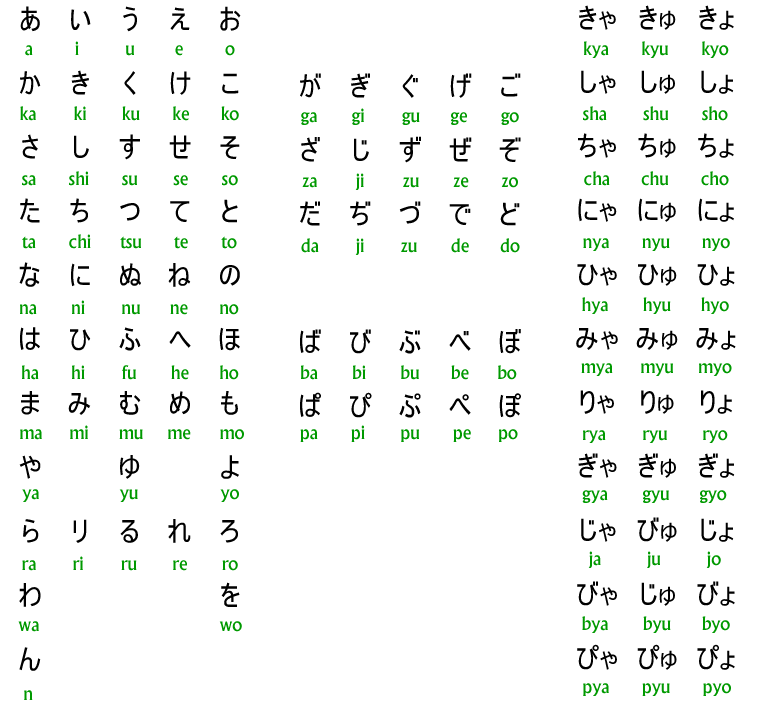
Around 800AD the Japanese people formed their own writing characters to meet the needs of their phonetic language. Japanese words are not built of individual letters like English, but rather of phonetic syllables. The new writing system became known as Hiragana. This system of 48 characters was used when there was no kanji for a native Japanese word as well as for when the kanji form is obscure.


Katakana

Around 800CE the Japanese crated another set of 48 characters called Katakana (Katakana and Hiragana are both kana systems). Katakana means “fragmentary kana”, as the katakana characters are derived from the components of more complex kanji. These kana were used primarily to transcribe foreign words into Japanese, the writing of loan words from other languages known as “gairaigo”, and to write onomatopoeia. Katakana is distinguished by its use of short, straight strokes and angular corners.


For now I think this is a good place to stop. I’m sure many of you are already swamped by all this new info. For anyone wanting to learn Japanese one of the easiest places to start is memorizing the two kana forms. Until next time,

じゃね。(rough translation - Bye, Ciao, or Peace)

Sunday, January 22, 2012

はじめまして (Hello)

はじめまして、

ネルソン・ウィリアムです。ノースウエスト・ビスタ大学の学生です。
サンアントニオからきました。すしが好きです。そして、アニメも好きです。スポーツはしません。しゅみはビデオゲームです。四人かぞくです。二人きょうだいです。父と母と姉が一人います。
どうぞよろしく。

Welcome

I am a student at Northwest Vista College in San Antonio, Texas. I have come to find an interest in Japan's history, culture, cuisine, language, art, and anything and everything I can learn about Japan.

I have already learned a great deal, but there is always more to learn. I still have yet to visit Japan in person, but I have learned a great deal through educational programing, first hand accounts from others, news, independent research, university classes, and just about any means I can. I still plan to make my way to Japan, but that will have to wait for when money and school allow for such an adventure of exploration and knowledge.

For now I will use this blog to post information I have gained already as well as post interesting Japan related things I find, and maybe some of my future trip ideas. I hope all my readers enjoy there time.

~PEACE (⌒▽⌒)